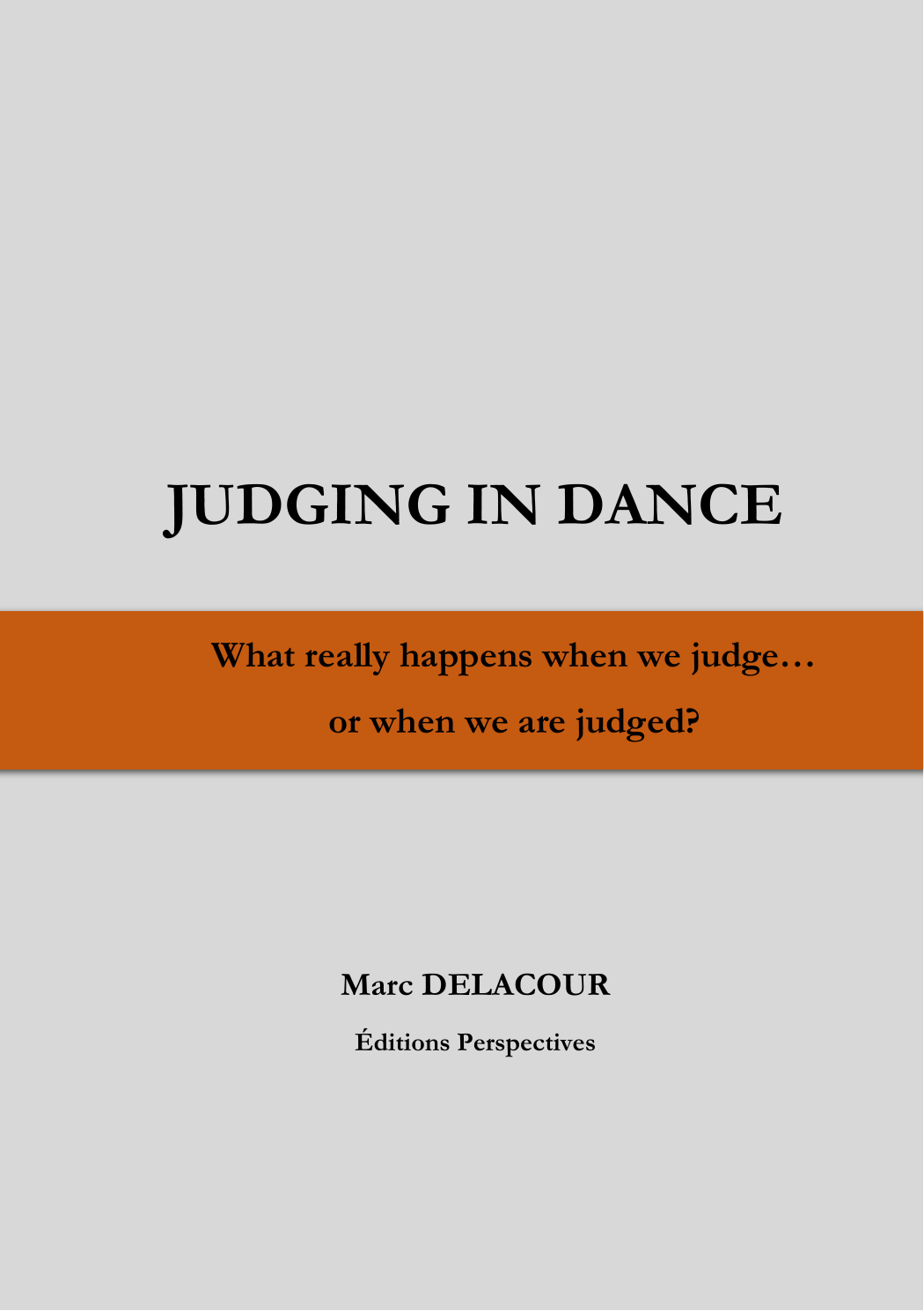
You may already have asked yourself one of these questions
Two competent adjudicators can watch the same performance without reading it in exactly the same way. The book begins with that reality and explores what happens between what we see and the decision we make.
Judgement is not a simple photograph of the performance
Observing, comparing and deciding involve human mechanisms. Understanding them does not diminish expertise; it helps us see more clearly what expertise relies on and where our own points of vigilance may lie.
Understand what captures attention
Selective attention, salience, immediate memory, experience, preferences, emotion and fatigue can influence what we notice, what we retain and what we compare.
Make the decision process more explicit
The aim is not to remove intuition, but to distinguish more clearly between impression, criteria, comparison and decision so that we can revisit our own practice with greater awareness.
What you will explore
The book brings together cognitive psychology, field situations and judging experience to put words to mechanisms that are often experienced without being clearly identified.
No perfect neutrality — but greater awareness
The book does not try to turn adjudicators into machines or remove every difference in appreciation. It invites readers to identify possible influences on attention, distinguish observed information from the impression produced, and build their own points of vigilance.
Understanding more clearly what influences our attention helps us take greater responsibility for the decisions we make.
Two complementary perspectives
The book is informed both by a scientific perspective on the mechanisms of judgement and by experience at the highest level of dance.
Patrick Lemaire highlights the breadth, relevance and accessibility of the psychological knowledge used to understand the activity of judging.
Patrick Lemaire
Professor of Psychology
Aix-Marseille University & CNRS
Steeve Gaudet points out that a better understanding of judging can help dancers regain control over what they present, help coaches guide their work more effectively and help adjudicators accept their responsibility with greater clarity.
Steeve Gaudet
Professional 10-Dance World Champion and Show Dance World Champion
15-time National Champion in France and Moldova — International Adjudicator
The book continues with you: Judging Assistant included
Once the book has been read, some questions only arise from your own experience. The Judging Assistant lets you explore a situation you have experienced, clarify a concept or continue a line of reflection grounded in the book.
Question: “I think I may have been influenced by a very visible couple. How can I avoid that at my next competition?”
The Assistant first distinguishes what attracted your attention from what actually supported your decision. It then asks you to step back: what did you really observe? Did you watch this couple for longer? Do you remember specific criteria, or mainly an overall impression?
The full example goes further: it explains a possible mechanism, helps separate “visible” from “better”, then suggests points of vigilance to adapt to your own way of judging.
The Assistant is multilingual and replies in the language of the question. It does not replace regulations, institutional frameworks or the adjudicator’s personal judgement.
Who is this book for?
Adjudicators and panel chairs
To question their own attention, explain their choices more clearly and recognise the constraints within which judgement is formed.
Dancers, couples and coaches
To understand more clearly how a performance may be perceived, compared and interpreted by different adjudicators.
Teachers, trainers and audiences
To move beyond a purely emotional or suspicious interpretation of results and better understand the role of the panel.
The book
Add one or more books to your cart, then pay for the whole order securely through Stripe.
A5 format — Éditions Perspectives.
Judging Assistant included with the book.
Delivery in France: €3 for a book order below €35; €0.01 from €35 of book purchases.
For readers outside France, the English editions are also distributed through Casa Musica.
Practical information
Publisher
Éditions Perspectives — Marc Delacour
Print ISBN
979-10-98289-30-9
Legal deposit
September 2026