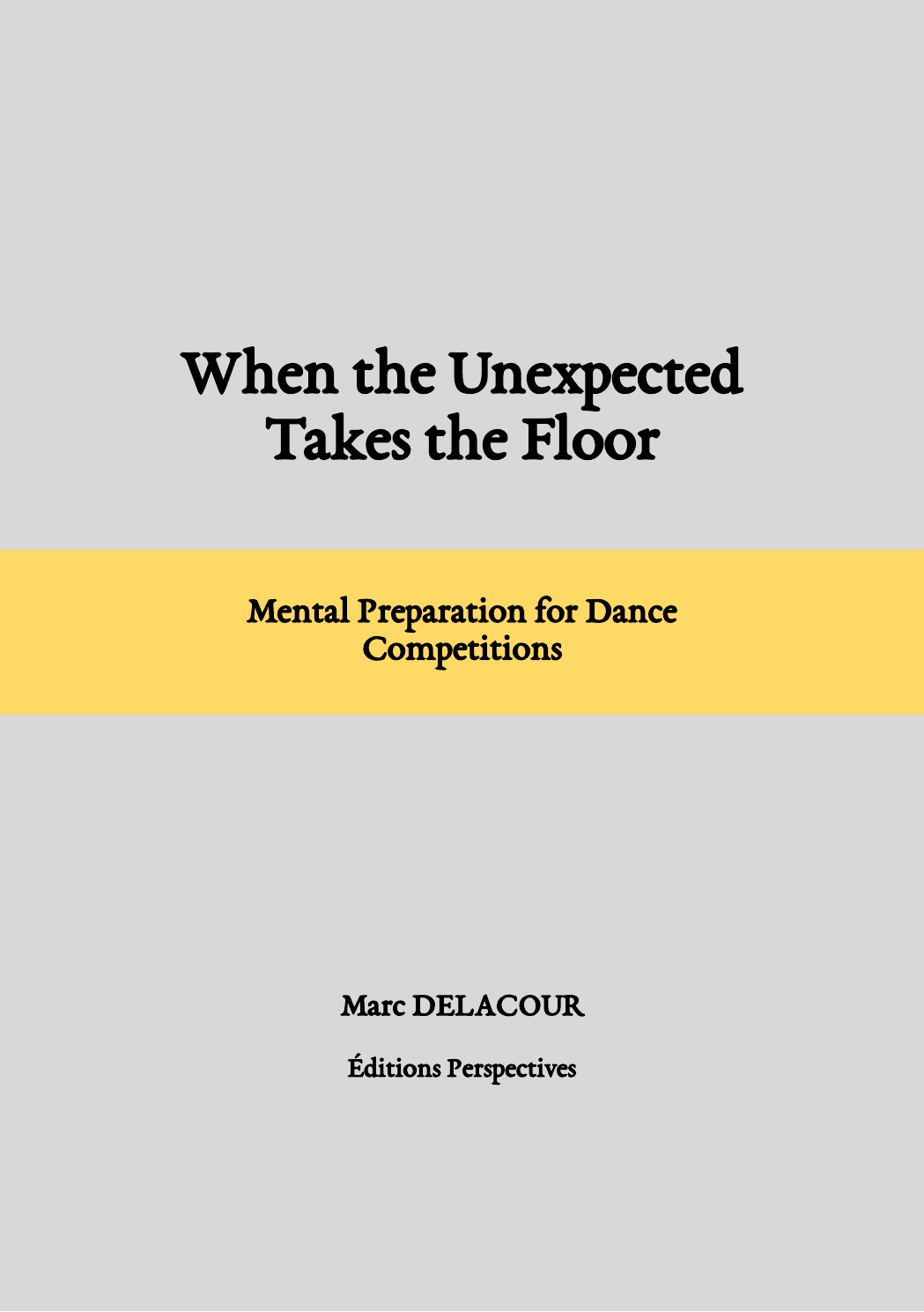
You may recognise yourself in one of these situations
The competition you actually face is never exactly the one you prepared for. Sometimes a few seconds are enough to unsettle reference points that felt completely secure in training.
The issue is not simply to “manage stress”
Understand what has changed
A mistake, an unfamiliar floor, music you would not have chosen, another couple, a loss of connection or an intrusive thought can alter attention, reference points and communication.
Prepare responses rather than a perfect scenario
The aim is not to make competition predictable. It is to widen your range of possible actions when reality no longer resembles the initial plan.
What you will work on
The book begins with concrete situations and explores several approaches drawn from mental preparation. It does not propose one universal method: it helps readers test, combine and build their own responses.
No miracle recipe. No universal profile.
Two dancers facing an apparently similar situation may need different responses. Research and tools are used here to illuminate mechanisms and open possible paths — not to turn field examples into rules that apply to everyone.
“Here is what you may be able to observe. Here are several possibilities. Now test them and discover what actually helps you.”
The book continues with you: Competitor Assistant included
A personal situation does not always fit neatly into a chapter. The Competitor Assistant extends the book: you describe what happened, and it helps you turn the book’s principles into lines of enquiry adapted to your situation. It is not intended to be consulted in the few seconds between two dances. Its value lies mainly in preparing beforehand or analysing afterwards, so that a response can be understood, tested and trained before it is needed.
The Assistant would not begin by imposing a routine. It would first try to understand what actually happened: what the dancer was thinking, what changed in the body or within the couple, what they tried, and what helped — or did not.
In the fuller example, three successive exchanges reveal that the dancer did not lose the music. Instead, they began trying to make up for the waltz, became tighter and carried that intention into the tango. They also explain that a prescribed breathing technique does not suit them, whereas a few seconds of silence and a simple bodily cue help more.
The possible response therefore becomes personal: learn to recognise the signal “I am trying to compensate”, test outside competition a return to a cue that genuinely suits this dancer, then observe whether it actually helps. Different answers from the dancer would have led to a different line of enquiry.
The Assistant is multilingual and replies in the language used to ask the question. It does not impose a single answer and does not replace a coach or individual professional support. Its role is to observe, question, connect elements of a situation and explore possibilities to test. The more personal the need, the more personal the response should become.
Who is this book for?
Competitors
To understand what changes between training and competition and prepare responses when a familiar reference point disappears.
Couples
To identify more clearly what happens in connection, communication and recovery after a difficulty.
Coaches and teachers
To use situations, questions and tools that help a dancer without imposing one universal recipe.
The book
Add one or more books to your cart, then pay for the whole order securely through Stripe.
A5 format — Éditions Perspectives.
Competitor Assistant included with the book.
Delivery in France: €3 for a book order below €35; €0.01 from €35 of book purchases.
For readers outside France, the English editions are also distributed through Casa Musica.
Practical information
Publisher
Éditions Perspectives — Marc Delacour
Print ISBN
979-10-982893-6-1
Legal deposit
September 2026